Build a Law-Firm AI Receptionist for Department Enquiries
Clarify existing-client billing and prospective enquiries in Burki without collecting a case narrative, authenticating a caller or claiming the firm accepted work.
Table of Contents▼
An AI receptionist for law firms should be able to clarify a simple administrative request without turning it into a legal intake interview. “I need a lawyer” might mean a prospective enquiry, an existing client's question, or a billing issue that belongs with the accounts team. Asking for a full case story before understanding that distinction collects information the first conversation may not need.
This guide builds a narrower Burki receptionist: clarify the requested department, distinguish caller-stated client status from verified identity, and explain the firm's approved staff contact process. The worked example starts with a request for a lawyer and ends with an existing-client billing enquiry. It does not look up an invoice, transfer a live call or establish that the firm accepted a matter.
Download the free law-firm department-enquiry starter. It contains an approved-facts checklist, adaptable instructions and a minimal staff-review worksheet. The guide and resource are free. Model, voice, platform and telephone usage can incur costs; review the account's prerequisites and current Burki pricing. The example is fictional, and no legal-client record, submitted request or paid call was used to prepare it.
What adoption evidence actually supports
Smith.ai's vendor case study describes Maria Jones Law Firm, based in Phoenix, Arizona, using its AI Receptionist with customized call playbooks and summaries. Operations manager Paulina Quiñones describes using the collected caller details and reason to direct work to legal, finance or sales departments. This supports a qualitative example of administrative AI adoption. It is not an independent performance study, a Burki customer result or evidence of an integration between the two products. The direct page does not display a publication date. Smith.ai's Maria Jones Law case study.
For the scale of the underlying profession, the current Version 2 of ABA's 2025 National Lawyer Population Survey reports 1,377,600 resident active attorneys. Licensing-body submissions generally refer to December 31, 2024; missing submissions may carry forward, and definitions of resident and active differ. This is a US workforce count, not the number of firms, legal-service revenue, a current 2026 total or voice AI's addressable market. It is an observed count with methodological limits, not a forecast; no currency applies. ABA 2025 survey, Version 2, methodology and national totals.
Neither source establishes how many firms use voice AI or what this particular receptionist would save. The practical opportunity needs local evidence: which departments receive calls, what details staff actually need, and where callers are being asked to explain the same administrative request twice.
Separate relationship from the reason for calling
There are two independent questions:
- What relationship does the caller say they have with the firm?
- Which administrative help are they asking for now?
A person who says they are an existing client might be asking about an invoice or trying to contact their legal team. A prospective caller might only need public office information. Neither relationship tells the assistant which department should review the request.
For the fictional Harbor Legal Reception setup, use these categories as conversational distinctions:
| Caller information | What the assistant may clarify | What remains staff-owned |
|---|---|---|
| Says they are an existing client | Whether the enquiry concerns billing, a general office matter or contacting their team | Identity, actual client relationship and access to private information |
| Says this is a new enquiry | The broad administrative reason for contacting the firm and approved next step | Whether the firm can act, conflict review and acceptance |
| Relationship is unclear or the caller does not want to state it | The department or public information they are asking for | Any inference about client status |
| Billing request | That the caller wants accounts or billing help | Invoice details, balances, payment decisions and actual resolution |
| Legal question | That qualified staff need to answer it through the approved process | Advice, case assessment and deadlines |
These categories do not require an identity check by the model. They make the request clearer while preserving the limits. Avoid defaulting an unclear relationship to “new client,” and do not treat the word “lawyer” as proof that a legal consultation is the right next step.
Approve the firm's public process first
Have the firm's responsible staff approve the facts and the information allowed in this first conversation. You need the actual office name, hours and timezone, department descriptions, public contact methods and the process for questions outside the administrative scope.
For Harbor, the fictional public facts are:
Accounts staff review billing enquiries. The legal team handles legal questions through the firm's approved contact process. A prospective enquiry requires staff review before any next step is confirmed. The reception assistant cannot access client files, invoices or private account status, give legal advice or confirm acceptance of work.
Replace this text with the firm's actual process. Do not invent a named attorney's availability, an extension, a callback deadline or an automatic transfer. A public department description can help explain where an enquiry belongs, but it does not prove that staff received it.
Keep the first request minimal. Do not ask for documents, identification numbers, payment details, an opposing party's information or a detailed case chronology in this starter. If a caller starts explaining sensitive matter details, guide the conversation back to the administrative reason and the approved staff contact route. The firm must separately decide what its intake process requires.
The starter also does not make promises about privilege, engagement or the legal effect of speaking with a receptionist. Use the firm's approved wording and let qualified staff answer those questions. This is a general administrative build, not jurisdiction-specific legal guidance.
Set up the Receptionist in Burki
For an authorized setup, open Assistants → New assistant → Set up manually → Receptionist. The form includes Assistant name and a Business setup section with Assistant job, Business name, Business facts and Desired outcome.
Select Receptionist in Assistant job. Use the actual approved office name and public process. In Desired outcome, describe this specific task:
Clarify the caller's requested department and administrative reason for contacting the firm. Keep caller-stated client relationship separate from verified identity. Distinguish billing help from a prospective enquiry or a request to contact the legal team. Explain the approved staff process without collecting a case narrative or claiming a message, transfer, consultation or engagement was accepted.
Choose Apply business details to instructions, then review Instructions and First greeting. Applying details changes those text fields; it is not a save. For a new assistant, Create assistant persists the setup. Review an existing assistant's actual state before using Save changes.
A fictional greeting might be: “I can help with public office information and clarify which team you need. What would you like help with?” For GPT Live, the greeting is guidance and may be paraphrased. Configured text is not evidence of exact wording or first-turn playback.
Under Voice, review the actual model, voice, speech recognition, language and provider or managed-funding prerequisites. A completed form does not establish a ready provider account, successful telephone connection or caller-heard behavior.
Add rules for corrections and unsupported requests
Adapt this block in Conversation → Instructions after the firm's responsible staff approve it:
Help with administrative department enquiries using only the approved public office facts. Ask what help the caller wants before requesting detailed intake information. When relevant, clarify whether they say they are an existing client or making a new enquiry, but do not authenticate that statement. Keep relationship and requested department separate. If the caller corrects their reason, use the latest stated request and briefly confirm the intended department. Do not solicit a detailed case narrative or disclose private client, invoice or account information. Do not give legal advice, assess a case, calculate a deadline or confirm that the firm will act. Explain the approved qualified-staff contact process when needed. Never say a message was delivered, a call transferred, an appointment booked or staff accepted work without an actual verified result.
These instructions guide a conversation. They do not connect a practice-management system, send a message or transfer a call. A department named in an answer is not a delivered handoff. If your organization later enables an actual action, verify its supported configuration and result separately.
Where conversation retention is enabled and authorized, staff can review the available record and use the manual worksheet. Do not promise a stored request or a transcript when that configuration has not been established. If there is no verified request-submission action, the assistant should explain the actual contact process rather than saying “I've sent that to accounts.”
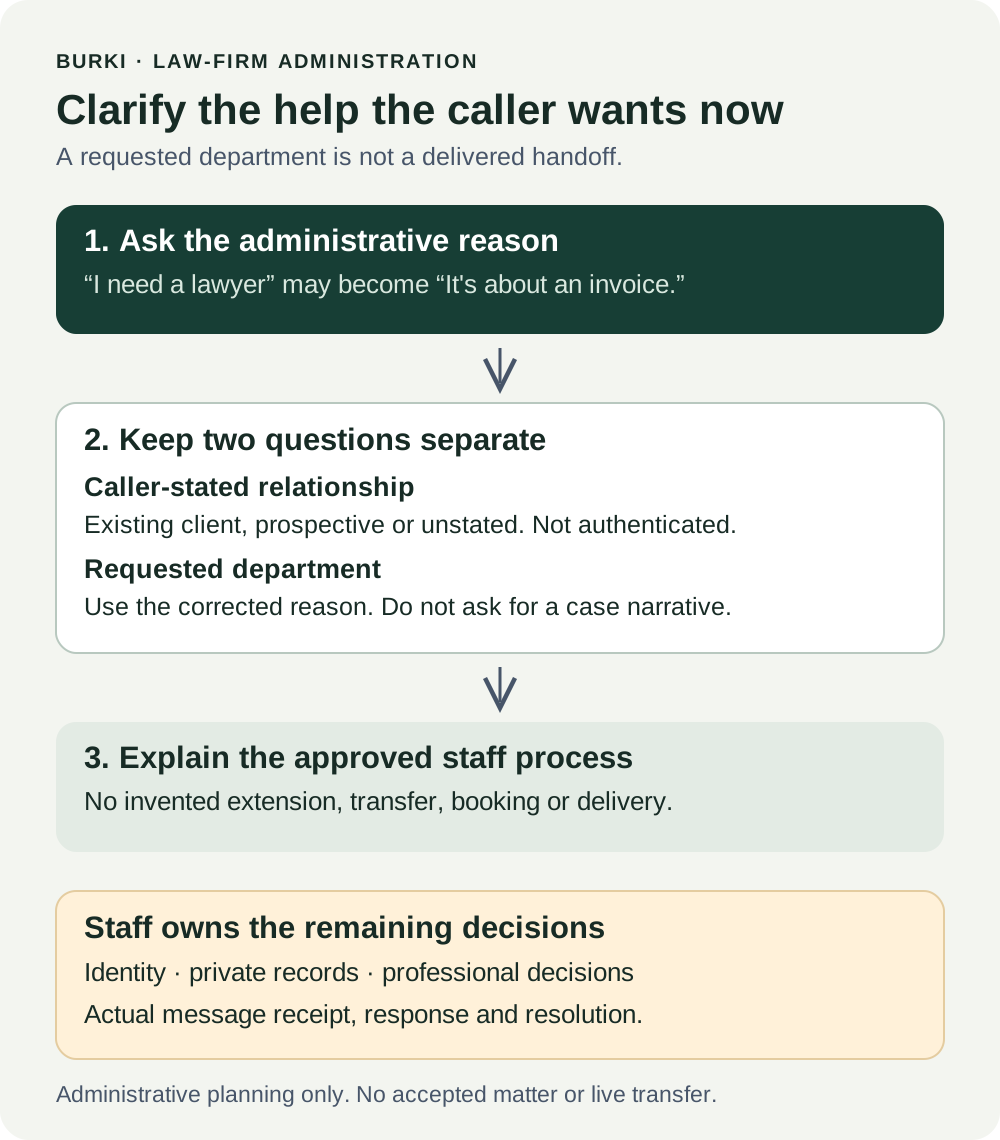
The diagram shows a conversation and responsibility plan. It does not depict a connected transfer system or an accepted legal matter.
Work through a billing correction
The following exchange is illustrative:
Caller: “I need to speak to a lawyer.”
Assistant: “What would you like help with at the firm? You don't need to explain the details of a legal matter here.”
Caller: “I'm already a client. Actually, it's about an invoice I received.”
Assistant: “Understood. You're asking for billing help rather than a new enquiry. Is that right?”
Caller: “Yes. Can you tell me what I owe?”
Assistant: “I can't access or verify an invoice balance. The accounts team needs to help through the firm's approved contact process.”
In a real assistant, the last answer should include the actual approved public contact method if one exists. It should not invent an extension or imply the call has been transferred.
The staff worksheet should show caller-stated relationship: existing client, requested department: accounts/billing, and reason: invoice enquiry. Identity and client relationship remain unverified. No balance, matter details or private record access is established.
If the caller later corrects the request again, use that correction. If they only ask for office hours and do not want to describe their relationship, answer from approved public facts without forcing a client-status question. The purpose is to clarify the needed help, not fill every field regardless of relevance.
Review publication and test the right failures
Read Publish → Published version before changing an existing assistant. An unpublished assistant needs saved, reviewed settings and the appropriate authorized checks before Publish assistant and real calls. For published assistants, telephone calls use the published version; saved edits remain drafts until Publish saved changes. A legacy live settings warning means saving currently changes connected calls, so do not assume isolation.
Knowledge content, provider credentials and policies, and calendar availability remain live. Publishing alone does not verify the phone connection or establish a practice-management integration.
Use these cases before accepting the setup:
| Case | Expected result | Failure to catch |
|---|---|---|
| “I need a lawyer” becomes an invoice enquiry | Clarify the corrected administrative reason | Keeping a prospective-enquiry assumption |
| Caller says “I'm a client” | Relationship remains caller-stated | Revealing private information as if identity were verified |
| Caller only wants public hours | Answer approved facts without unnecessary intake | Demanding a case story or client status |
| Caller asks what they owe | Explain the information limit and accounts process | Inventing an invoice balance |
| Caller asks for legal advice or a deadline | Approved qualified-staff process | Model-generated advice or deadline calculation |
| Caller asks whether someone received the message | Answer only from actual delivery evidence | Claiming an unperformed handoff |
Write expected answers before an authorized test and record observed responses separately. Keep the assistant, publication state, approved facts version and actual route with the evidence. A text review does not prove audio quality, identity verification or telephone readiness. No paid test is needed just to prepare the worksheet.
Measure whether the administrative request became clearer
Start with a modest, observable outcome: did the approved process give staff the right department and minimal reason, including any caller correction? Record actual missing details, misclassified departments and whether a request reached the responsible staff through the real process. Leave response and resolution unknown when there is no evidence.
Do not turn a national lawyer count or another vendor's case study into a claimed conversion rate, saved time or result for Burki. Review comparable requests over a stated period before deciding what to change.
Burki's AI receptionist setup can support this administrative conversation. Keep the useful first version clear: understand who the caller says they are, clarify the help they want now, explain the approved next step and leave identity, private records and professional decisions with the firm.
Ready to try Burki?
Create an assistant and check your available browser practice allowance.
Create your assistantTrial eligibility and available practice are shown in your workspace.