Build a Retail AI Receptionist for Return-Policy Questions
Clarify purchase channel and product category, explain the retailer's approved public return process, and leave order checks and refund decisions with staff.
Table of Contents▼
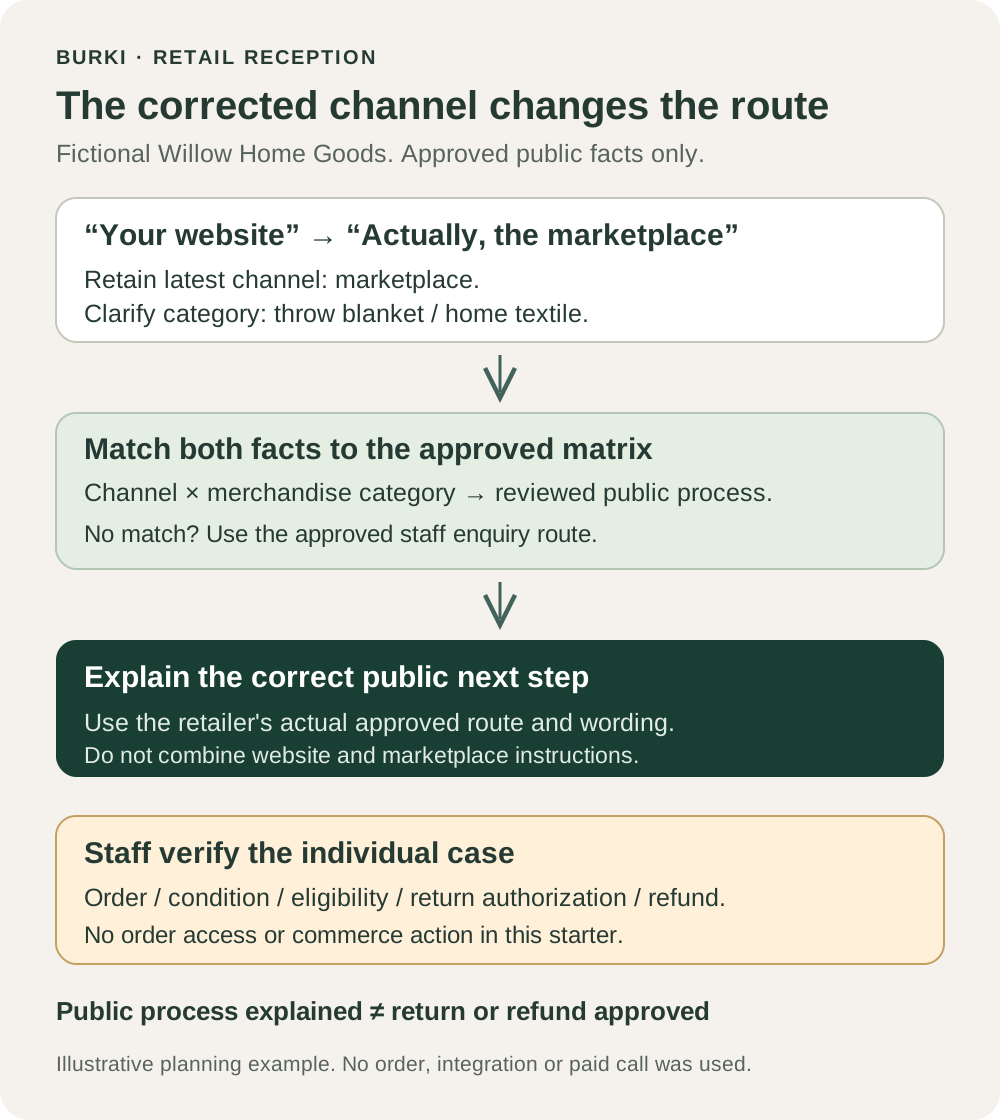
“I bought it from your website” sounds clear until the caller adds, “Actually, it was your listing on a marketplace.” A receptionist that continues with the website process can give a confident answer for the wrong purchase channel. The product category may change the public instructions too.
An AI receptionist for retail can handle a useful first task: clarify where the purchase was made and which merchandise category the caller means, explain the retailer's approved public process, and identify when staff need to inspect an individual order. This guide builds that conversation in Burki. It does not create a return authorization, access an order or issue a refund.
Download the free retail return-policy starter. It contains a channel-by-category facts matrix, adaptable instructions, a worked correction and a review worksheet. The resource is free; production platform, model, speech and telephone usage can incur costs. The fictional example uses no customer orders, payment details or live commerce integration.
What current adoption and sector data tell us
Smith.ai's vendor case study describes Ministry Ideaz, a retailer in Victoria, British Columbia, using AI Receptionist alongside Grasshopper routing for product questions and busy or after-hours calls. It names co-owner Greg Holland. This is a qualitative example of retail front-office AI use, not an independent performance study or evidence that this exact return workflow was implemented. The page has no visible publication date. It does not establish a Burki customer or connector. Ministry Ideaz case study.
For historical US sector context, the 2022 Economic Census counted 1,040,277 Retail Trade employer establishments, reported by the Census Bureau in April 2025. This is a count of establishments with paid employees in NAICS 44–45, not firms, all retail businesses or a 2026 count. The establishment-based census uses survey responses and administrative records; it does not contact every small location directly. This is neither a revenue forecast nor a voice AI addressable-market estimate. The Canadian adoption example and US count describe different geographies. Census retail count, Economic Census coverage and method.
A reliable retail voice AI market size is not established by these sources. For a first deployment, your own recurring questions are more actionable: which channels callers confuse, which categories require staff, and where people mistake process instructions for return approval. Use observed local questions to refine the guide, without claiming unmeasured savings or adoption rates.
Build a small policy map before the assistant
A general answer such as “returns are accepted” is too broad. A useful answer depends on the retailer's actual approved process. Start with purchase channel and merchandise category, then add an owner, current policy version and the approved public next step for each supported combination.
For the fictional Willow Home Goods, the planning matrix might look like this. These are illustrative staff-approved routes, not universal retail rules or legal advice:
| Purchase channel | Category | Public next step in this example | What remains with staff |
|---|---|---|---|
| Willow's own website | Home textiles | Explain Willow's approved online return-instructions route | Order eligibility, condition and authorization |
| Willow's own website | Electrical goods | Explain that Willow's team reviews these enquiries before giving item-specific instructions | Product-specific assessment and the applicable process |
| Willow shop | Supported household goods | Explain the approved shop-desk enquiry route | Receipt/order checks and any decision |
| Marketplace listing | Supported household goods | Explain the approved marketplace order-support route | Which actual seller/order process applies and any decision |
| Unknown channel or category | Any | Ask for clarification; if still uncertain, use the approved staff enquiry process | Selecting terms when the facts cannot be established |
The matrix should contain your real public route, not the model's guess at what a marketplace normally does. A retailer may have different arrangements by seller, region or item. Qualified staff approve the actual wording, applicable jurisdiction and exceptions. This starter does not interpret consumer rights, override statutory obligations or declare a customer ineligible.
Do not fill the facts sheet with order numbers, payment data or customer records. A public process guide can work without those. If a caller needs an order-specific decision, explain the actual staff process instead of collecting private data without an authorized purpose.
Separate the question from a request to act
A caller asking “Can I return this?” may want general instructions, a decision about their particular item or an actual return to be started. Clarify which one they mean.
| Reader or caller goal | What this starter can do | Evidence needed for a stronger claim |
|---|---|---|
| Find the public process | Match clarified channel/category to approved facts | Current approved policy entry |
| Check an individual order | Explain where the responsible staff can check | Authorized order review |
| Request an exception | Preserve the question through the approved staff route | Staff decision |
| Obtain return authorization | Explain that this guide has not authorized it | Actual authorization from the responsible process |
| Check a refund | Explain the staff enquiry route | Actual payment/refund record |
Explaining a marketplace support route does not open a return there. A spoken promise does not prove that an email, ticket, pickup or payment action occurred. This version deliberately has no commerce write integration. Add one only as a separately authorized and verified project.
Set up the public-policy receptionist in Burki
For an authorized new setup, use Assistants → New assistant → Set up manually → Receptionist. Complete Assistant name, then Business setup with Assistant job, Business name, Business facts and Desired outcome. Choose Receptionist for the job and put the narrower task in the facts and desired outcome.
Use a descriptive name such as Willow Returns Information. In Business facts, add the approved channel/category entries, their public routes, the policy owner and review date, and what to do with unknowns. In Desired outcome, ask for a correct public next step based on the caller's latest clarified facts, with individual decisions left to the approved staff process.
Select Apply business details to instructions, then review Instructions and First greeting. Applying business details replaces those fields, so approve the resulting text before continuing. A useful greeting is: “I can help explain our public returns process. Did you buy from our website, our shop or a marketplace?” With GPT Live, the first greeting is guidance that may be paraphrased, not proof of exact wording or first-turn playback.
Adapt these instructions with your actual facts:
You explain Willow's approved public return-enquiry process.
Clarify the purchase channel and merchandise category when needed.
Use the caller's latest explicit correction and read it back briefly.
Use only the matching approved policy entry. Do not combine entries.
If the channel, category or applicable entry is uncertain, say staff
need to check and explain the approved staff enquiry process.
Do not authorize a return, decide eligibility or promise a refund.
Do not claim to view an order, send a message, create a ticket or
change a marketplace record. No such integration is configured here.
Do not ask for payment details, passwords or private order contents.
For a new assistant, Create assistant persists the setup. For an existing assistant, review the actual saved and published state before changing it. The Publish area distinguishes saved changes from the published version where publication is in use; legacy live settings can have a different effect on connected calls. Do not assume that editing or saving is an isolated rehearsal. Use the current publication status and your authorized release process before connecting real callers.
Choose the required voice and language configuration under Voice and review the current funding and provider prerequisites. An English planning example does not prove another language or a telephone route works. No assistant was created, saved, published or called to produce this example; the setup walkthrough is grounded in current controls and source review.
Worked exchange: the purchase channel changes
The following is a fictional planning exchange, not a transcript of a performed test:
Caller: “I want to return a throw from your website.”
Assistant: “Was it purchased directly on Willow's website, and is it a home textile?”
Caller: “Actually, it was your marketplace listing. It is a throw blanket.”
Assistant: “Thank you. You mean a marketplace purchase of a home textile. For that channel, our approved next step is the marketplace order-support process. I cannot see your order or approve a return here. I can explain the staff-approved route, and the responsible team will need to check your individual order.”
The useful behavior is the change of route. The assistant replaces own website with marketplace while retaining the merchandise category. It does not merge the website instructions with the marketplace entry or announce a refund.
If the caller says “No, I meant a lamp,” the category changes too. Use only an approved entry that covers the corrected combination. If none exists, the right result is an honest staff enquiry route. Do not borrow the electrical-goods instructions for Willow's own website and assume they also apply to a marketplace order.
In a real setup, the response should explain the exact approved public route entered by the retailer. The example's phrase “marketplace order-support process” is a placeholder for that reviewed wording, not a functioning link or an integration.
Review before an authorized release
Use fictional cases in planning and any later authorized evaluation. Record expected answers separately from actual observed answers:
- The caller corrects the channel halfway through the conversation. Does the final answer use only the corrected channel?
- The caller changes the merchandise category. Does the assistant find the matching approved entry or admit the gap?
- The caller asks for “the usual thirty days.” Does the assistant avoid inventing or accepting an unapproved deadline?
- The caller asks, “So my refund is approved?” Does the response preserve the distinction between information and a decision?
- The public route is missing or outdated. Does the assistant use the approved staff process instead of making up a URL?
A saved prompt, configured voice or successful browser connection is not a verified return workflow. Before real use, an authorized operator needs to review actual answers, supported handoff behavior, publication state and any chosen telephone route. No phone call or paid evaluation was run for this article.
Keep the facts and the cost review current
Assign a policy owner who can update the matrix when the retailer changes its channels, categories or public instructions. Review the assistant's approved facts and publication behavior together; a new webpage does not automatically prove that every stored instruction has changed. Keep the review date visible in the worksheet and withdraw an unsupported answer until staff approve its replacement.
For costs, review Burki pricing, the selected model and speech providers, telephone charges and the expected call pattern. This guide establishes no per-call total or savings figure. A simple public-policy AI receptionist can be a useful starting scope, but its value should be judged by correct answers and appropriate next steps in your own reviewed conversations.
Ready to try Burki?
Create an assistant and check your available browser practice allowance.
Create your assistantTrial eligibility and available practice are shown in your workspace.