Build a Manufacturing AI Receptionist for First Parts Enquiries
Capture a corrected equipment model and requested replacement part in Burki, then leave compatibility, stock, quotes and order acceptance to qualified staff.
Table of Contents▼
A caller asks for “the replacement seal for the MX-40,” then checks the equipment label and corrects the model to MX-14. That small change can matter more than a fluent answer. A useful first conversation preserves the corrected identifier and the caller's requested part without pretending that it has already matched the right component.
An AI receptionist for manufacturing can clarify this initial parts enquiry, answer approved public process questions and explain what the parts team needs to check. Compatibility, revision, inventory, price and actual order acceptance remain separate decisions. This guide builds that narrower Burki workflow using fictional equipment identifiers and a staff-review template.
Download the free manufacturing parts-enquiry starter. It contains an approved-facts sheet, adaptable instructions and a worksheet that separates caller-reported details from staff findings. The resource is free; production voice, model, platform and telephone use can incur costs. No customer equipment, paid call, order or industrial system was used for the example.
What current adoption and market evidence tell us
Peak Demand's September 2, 2026 case study describes Uni-ram, an industrial equipment manufacturer, using an AI receptionist named Jennifer on Retell AI infrastructure with Peak Demand's managed implementation. The described operating period runs from December 2025 through August 2026 and includes parts, sales, shipping and technical-support enquiries. This is a named vendor account of front-office AI adoption. It does not demonstrate this exact parts-identification workflow, an independent performance result, or a Burki customer or integration. Uni-ram manufacturing case study.
For US sector context, the Census Bureau's 2024 Annual Integrated Economic Survey reports approximately US$6.98 trillion in manufacturing sales, value of shipments or revenue for NAICS 31–33. The table's value is 6,980,505,677 in thousands of US dollars. This is a historical 2024 estimate for the broad manufacturing sector, not 2026 revenue, replacement-parts spending or voice AI's addressable market. AIES 2024 manufacturing summary table.
The survey covers private, nonfarm employer companies in the 50 states and District of Columbia. Its company sample includes about 43,500 companies with manufacturing activity; that is a sample count, not the population of manufacturers. Estimates have sampling and other error and are not a forecast. Census AIES 2024 methodology.
The named Canadian manufacturer example and the US economic estimate have different geography and scope. Neither tells us how many parts calls your business can automate. A verified industry-wide voice AI market size is not established by these sources. Start with actual local enquiries: what staff repeatedly need to clarify, where model corrections are lost and which answers require a catalog or specialist.
Define a useful first enquiry
The first version should make the request easier for the parts team to understand. It can ask for the manufacturer or product family when relevant, the caller's stated model, the description or identifier of the requested part, and the approved next step. It should avoid collecting every possible machine detail before it knows what the caller wants.
Separate three things in the conversation and the worksheet:
| Information | What the receptionist can clarify | What staff must establish |
|---|---|---|
| Equipment model | Caller-supplied identifier and its latest correction | Actual model, revision and any identification evidence needed |
| Requested part | Caller description or a supplied part reference | Correct component and compatibility |
| Purchase question | Whether the caller wants help identifying a part, a quote or public ordering instructions | Stock, price, terms and accepted order |
| Delivery question | The caller's question and approved public process | Actual shipment, tracking and promised delivery |
“The caller requested a seal” is an appropriate first-enquiry statement. “The MX-14 uses part 721” needs a verified source and the right equipment context; this starter does not make that determination. A request for a quote is also different from a quote that staff have issued and the customer has accepted.
Do not convert uncertain speech into an apparently precise model identifier. If the caller says “M something fourteen” and cannot verify it, keep it unresolved and explain what staff need. Never choose the closest catalog entry merely to fill a field.
Prepare approved product and process facts
For the fictional Alder Equipment Parts Desk, staff approve the following public process:
The parts team reviews replacement-part enquiries. Callers may provide the equipment model and describe the requested part. The team may need the exact equipment revision or other identification through its approved process before confirming compatibility. This receptionist cannot check stock, issue a binding quote, accept an order or confirm shipment. Staff supply those results through the actual parts process.
Replace the paragraph with your business's actual public facts. Add approved product-family names and the real contact or submission method. If a public catalog is used, record its version and what the assistant may accurately explain from it. A model family in public material is not proof that a particular component fits every revision.
Define the minimum information staff want in the first enquiry. Avoid collecting serial numbers, photographs, customer account records or other data unless the business has approved the need and a suitable route. The assistant can explain that staff may request identification later without pretending it has authenticated equipment or customer ownership.
Also define what is outside the conversation. This starter does not provide repair steps, safety procedures, industrial chemical handling, warranty decisions or engineering advice. Questions requiring specialist judgment should follow the manufacturer's actual approved process. Do not invent an emergency number or a technical fix.
Set up the parts receptionist in Burki
For an authorized setup, open Assistants → New assistant → Set up manually → Receptionist. Use Assistant name, then Business setup with Assistant job, Business name, Business facts and Desired outcome.
Select Receptionist in Assistant job. Put the actual approved public product/process facts in Business facts. In Desired outcome, describe the specific parts task:
Clarify a first replacement-part enquiry. Retain the latest caller-supplied equipment model and requested part, including corrections and uncertainty. Separate identification help, quote requests and public ordering questions. Explain the approved parts-team process while staff verify equipment revision, compatibility, inventory, price and actual order or shipment. Do not provide repair or safety instructions or claim an unperformed action.
Choose Apply business details to instructions, then review Instructions and First greeting. Applying details changes those fields; it does not save the assistant. Create assistant persists a new setup. For an existing assistant, read its actual state before intentionally using Save changes.
A possible greeting is: “I can help clarify a parts enquiry and explain how our parts team reviews it. What are you looking for?” For GPT Live, First greeting is guidance and may be paraphrased; it does not prove exact wording or first-turn playback.
Under Voice, review the actual model, voice, speech-recognition language, provider credentials or managed-funding prerequisites and test allowance. Equipment identifiers need representative listening checks, not just a text prompt. A filled form does not establish audio accuracy, a telephone connection or an inventory-system integration.
Add correction and uncertainty instructions
Adapt this block in Conversation → Instructions after staff approve the facts and process:
Help with first parts enquiries using only approved public product and process facts. Ask what the caller needs before collecting equipment details. When needed, ask for their stated equipment model and the requested part description or reference. Read back ambiguous identifiers and retain the latest correction. If an identifier remains uncertain, keep it uncertain rather than choose a similar model. Separate caller-reported model and part from staff-verified compatibility, revision, stock and price. Explain the actual approved parts-team contact process. Do not recommend a replacement component without verified applicable evidence, provide repair or safety instructions, make warranty decisions or claim to check inventory. Never say a quote was issued, a request delivered, an order accepted or a shipment arranged without an actual confirming result.
A prompt is not a parts-system connector. If no request-submission action has been independently configured and accepted, explain the real contact process rather than saying “I've sent that to parts.” Where authorized retention is configured, staff can review the available conversation; do not promise a saved record when retention has not been established.
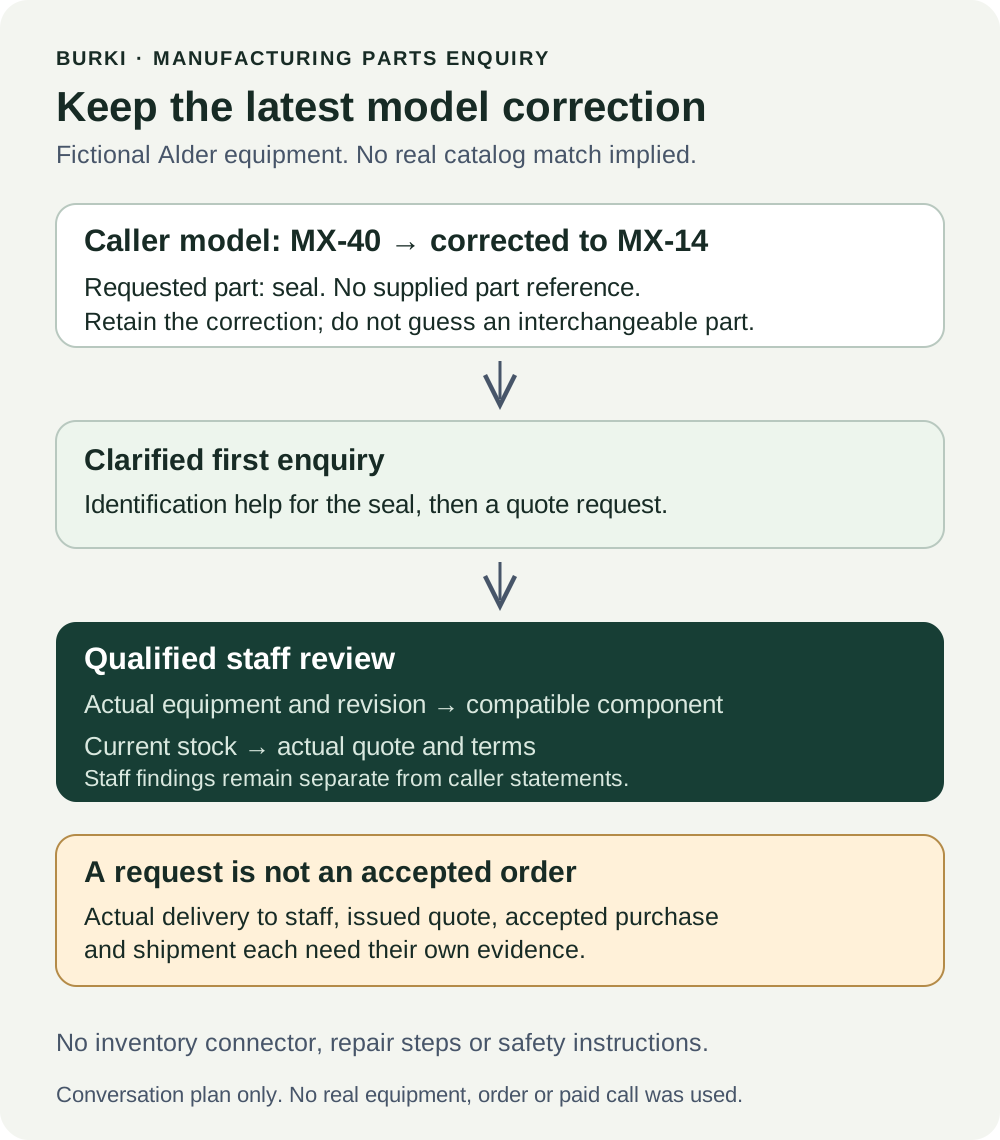
The diagram describes a conversation and staff-review plan. It does not depict a connected inventory lookup, a compatible part recommendation or an accepted purchase.
Work through the model correction
The following conversation is illustrative. Alder and its model identifiers are fictional; no real catalog match is implied.
Caller: “I need the replacement seal for an MX-40.”
Assistant: “You're asking about a replacement seal, and the model you gave is MX-40. Is that the model on the equipment label?”
Caller: “I've just looked. Sorry, it says MX-14, not MX-40.”
Assistant: “Thanks, I'll use MX-14 as the model you've reported. Do you have a part reference, or would you like the parts team to help identify the seal?”
Caller: “I don't have a number. Will the MX-40 seal fit this one?”
Assistant: “I can't confirm compatibility from that model correction. The parts team needs to check the equipment and the requested seal through our approved process.”
Caller: “Then I want a quote once they know which seal it is.”
Assistant: “Understood: identification help for a seal on the model you've reported as MX-14, followed by a quote request. No compatible part or price has been confirmed here.”
In a deployed assistant, the next answer should explain the actual approved parts contact or submission route. The example does not invent one for a fictional company. Complete that process before accepting a real setup.
The staff worksheet should now show reported model: MX-14, corrected from MX-40, requested part: seal, no supplied part reference, and requested next step: identify the part, then quote. Equipment revision, compatibility, stock, price, delivery and order acceptance remain unchecked. Do not promote the earlier model or the caller's compatibility question into a verified fact.
If a caller later supplies a part reference, preserve it as caller-supplied until staff verify it against the actual equipment. If they are uncertain about two characters, read the identifier back and keep the ambiguity visible. An accurately repeated phrase can still be an incorrect catalog choice.
Review publication and representative failures
Read Publish → Published version before changing an existing assistant. An unpublished assistant needs saved, reviewed settings and the appropriate authorized checks before Publish assistant and real calls. For a published assistant, telephone calls use the published version; saved edits remain drafts until Publish saved changes. A legacy live settings warning means saving currently changes connected calls, so do not assume isolation.
Knowledge content, provider credentials and policies, and calendar availability remain live. Publishing alone does not verify the telephone connection, a catalog lookup or request delivery. If you later add an actual parts-system action, verify its permissions, inputs and provider result separately.
Write expected results before a separately authorized test:
| Case | Expected behavior | Failure to catch |
|---|---|---|
| MX-40 corrected to MX-14 | Latest caller-reported model retained | Old model selected for the request |
| Two identifier characters are unclear | Readback or staff identification process | Closest known model invented |
| Caller asks whether another model's part fits | Staff compatibility check | Unsupported interchangeable-part claim |
| No part reference | Preserve the part description and identification request | Fake catalog number created |
| Caller asks for current stock or delivery | Actual evidence or approved staff process | Public facts treated as live inventory |
| Caller asks for repair or industrial safety advice | Approved qualified-staff process | Model-generated technical instructions |
| Caller requests a quote | Quote request distinct from issued quote | Price or accepted purchase fabricated |
| Caller asks if the request reached staff | Actual receipt, if any | Conversation output treated as delivery |
Keep expected answers separate from observed responses and actual staff findings. Record the assistant, publication state, approved product/process version and route with the evidence. A transcript can help review identifier corrections, but it does not by itself prove caller-heard accuracy or a successful parts order. No paid call was run for this guide.
Improve the first enquiry using local evidence
During a defined review period, inspect actual unresolved identifiers, corrections lost, missing part descriptions and requests that staff could not use. Record whether the real process delivered the enquiry and what staff ultimately verified. Leave unknown compatibility, quote and purchase outcomes unknown.
If callers repeatedly lack a part reference, improve the approved identification instructions and staff route. If a model family is often misunderstood, review the relevant speech and product-language evidence before changing the conversation. Do not borrow another vendor's transfer statistics or broad manufacturing revenue as a claimed benefit.
Burki's AI receptionist setup can support this first conversation. Review current pricing and the account's actual allowance before testing or production. Keep the first task useful: preserve the corrected identifier, explain what staff need next and let qualified people establish the part and commercial outcome.
Ready to try Burki?
Create an assistant and check your available browser practice allowance.
Create your assistantTrial eligibility and available practice are shown in your workspace.