Build an AI Receptionist for Hotels: Arrival Questions and Staff Handoff
Set up a hotel voice agent for approved arrival, parking and reception questions, with a free worksheet for date corrections, guest requests and staff review.
Table of Contents▼
An AI receptionist for hotels has to separate two kinds of question. “Where is the public car park?” can be answered from an approved property guide. “Can I enter my room at 01:15?” depends on a reservation, arrival arrangements and the hotel's access procedure. A confident answer is only useful if the assistant has the authority and evidence behind it.
This guide builds a first hotel voice agent in Burki for public arrival questions and staff-reviewed requests. It explains reception hours, parking directions and approved arrival procedures, then captures the information staff need for an exception or reservation-specific enquiry. It does not connect a property management system, change a booking, take payments or disclose room access codes.
Download the free hotel arrival starter kit. It includes a property facts worksheet, adaptable instructions, a request record and acceptance cases. The article and template are free; production voice usage and any telephone route have costs.
Where hotel voice AI is already being used
Hotel voice AI is an established application, but deployments vary widely in scope. PolyAI's Golden Nugget customer page describes FAQs, call routing and hotel reservation workflows. That is evidence of a named implementation, not evidence that every hotel system or voice platform can support the same tasks.
In a March 2023 customer account, Golden Nugget contact-center director Brian Jeppesen dates the initial front-desk launch to April 2021, followed by reservation capabilities and wider deployment. This is a dated customer account hosted by its vendor, not a new 2026 launch, independent performance study or Burki customer result.
Use examples like that to understand what an integrated hotel operation can build. Keep your own first version tied to the systems and actions you have actually verified. Public information and a well-formed staff request can be useful before live reservation integration exists.
Put the market figures in the right scope
Oxford Economics' AHLA economic-impact report, published in January 2025, estimates the 2024 US sector at more than 64,000 properties and nearly 5.7 million guestrooms. Its US$352.3 billion direct hotel-operations output includes revenue and certain taxes. The definition covers hotels and motels, casino hotels and bed-and-breakfast inns. The methodology combines sources including STR, Census, BEA and IMPLAN; the output is an economic estimate, not a software spending figure.
For newer context, AHLA's January 2026 summary forecasts nearly US$805 billion of hotel guest spending in 2026. That broad spending measure is different from hotel operations output and is a forecast. Neither figure measures voice AI's addressable market. A property's actual opportunity depends on its enquiry volume, unresolved requests, integrations and operating costs.
The useful planning question is smaller: which repeated arrival questions can this property answer accurately, and which still need a person?
Define the boundary by question
Our fictional property is Alder Quay Hotel, one location with a staffed reception desk from 07:00 to 23:00. Its public guide says parking is at the North Quay entrance and normal check-in starts at 15:00. These facts are examples, not policies to copy into your hotel.
Staff must confirm individual late-arrival arrangements. Early check-in, room changes and access problems also need staff. The assistant has no reservation lookup or property management connection in this build.
| Guest question | First version can do | Staff must confirm |
|---|---|---|
| “Where should I park?” | Give the approved public entrance and directions | An exception, reserved space or unusual vehicle arrangement |
| “When does reception close?” | State the approved desk hours | Who will meet this guest outside those hours |
| “I arrive after midnight.” | Clarify local arrival date/time and capture the request | Whether the reservation and arrival procedure allow it |
| “Can I check in at 10:00?” | Explain the normal check-in time and offer a request | Availability and approval for early check-in |
| “What is my door code?” | Explain the approved staff contact procedure | Identity and access authorization through the hotel's process |
Do not put individual room codes, guest lists, payment details or private reservation notes into the public facts. A hotel after-hours answering flow should also offer the approved human contact route. If the hotel has no approved route or late-arrival process, settle that operational question before using an assistant to describe it.
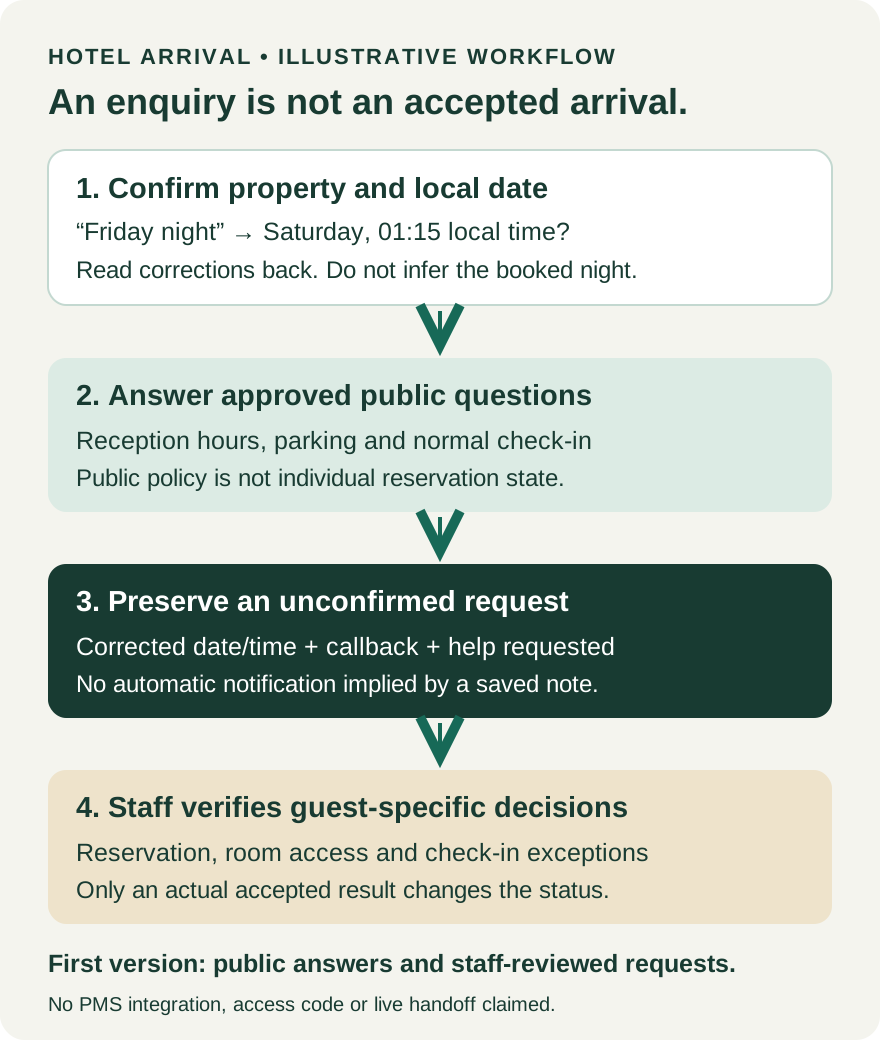
Public facts and guest decisions follow different paths. This is a planning diagram, not a screenshot of a completed hotel request or transfer.
Prepare the property facts and costs
Use a verified Burki account and the intended workspace. Choose a supported configured voice stack, review provider credentials and the available funding mode, then save the assistant's instructions. Provider selection does not by itself establish hotel booking or telephone readiness.
Production costs depend on the selected model and voice providers, Burki's applicable usage charges and whether you use your own provider credentials. A telephone path adds number and carrier charges. Optional integrations can have their own costs and prerequisites. Review the current quote and pricing information for your actual configuration; the free download is not a promise of free calls.
Collect these facts from the hotel's responsible operator:
- Exact property name, public address and approved wording for similar locations.
- Local timezone, reception hours and holiday exceptions.
- Normal check-in/check-out times and the language for unconfirmed exceptions.
- Public parking and arrival directions, including what is not included.
- Staff contact route for an arrival problem and the approved fallback if nobody is available.
- The owner and review date for each fact.
Keep rapidly changing state outside the static sheet. A document can describe the normal check-in time. It cannot tell the assistant whether tonight's room is ready or whether a particular reservation exists. Review outdated-source handling with the knowledge freshness guide.
Set up the assistant in Burki
From Assistants, choose New assistant, Set up manually, then Receptionist. In Conversation, use the business setup area to establish the job before adjusting style.
For the fictional property, choose Receptionist under Assistant job. Enter Business name as Alder Quay Hotel. In Business facts, add only the approved public facts and the reservation/access boundaries. Set Desired outcome to “Answer public arrival and parking questions or collect a minimally complete request for reception review.” Keep reservation changes outside this assistant’s authority.
Choose Apply business details to instructions, then read the generated instructions in full. Add the explicit date and property checks from the starter kit. Generated wording is a draft to review; it cannot supply missing policy, hotel-system access or staff availability.
The core instructions can be adapted like this:
You are the arrival enquiry assistant for Alder Quay Hotel. Identify the property when there is ambiguity. Answer approved public reception, parking and check-in questions from the saved facts. For late arrival, early check-in, reservation changes or access problems, explain that staff must confirm the individual arrangement. Clarify the local arrival date and time, then collect only the name, callback detail and short request needed for follow-up. Read corrected details back. Do not disclose room codes, confirm a reservation, promise availability or say a request has been accepted without a verified result.
Keep an approved human contact option in the conversation. If staff action is needed immediately, provide the operator-approved route rather than promising that someone is already on their way. Do not invent an emergency procedure or an after-hours duty number.
Work through the after-midnight correction
Here is an illustrative conversation for the fixture, with no live call performed:
Guest: I'll arrive Friday night, around quarter past one.
Assistant: Do you mean 01:15 on Saturday in the hotel's local time, after Friday evening?
Guest: Yes, Saturday the 10th. And it is Alder Quay, not your Alder Lane property.
The important detail is not just “late arrival.” The local arrival date is now Saturday October 10, 2026 at 01:15, and the property is Alder Quay. Staff may also need to relate that arrival to the booked night. Without a reservation lookup, the assistant cannot infer that relationship or say the booking is confirmed.
A useful next response would be:
Thanks. I have Alder Quay Hotel, arriving Saturday October 10 at 01:15 local time. Reception needs to confirm the late-arrival arrangement for your stay. What callback detail would you like the team to use?
This response is an example of the intended behavior, not an observed product result. In your own test, inspect what was actually said and retained. If “Friday night” remains in the review note after the correction, the request is not ready for staff.
The request record should state the property, explicit local arrival date/time, corrected detail, callback information and status: requested, not confirmed. Leave the reservation match and acceptance fields unknown. Do not substitute a caller's guess for a staff decision.
Decide how reception will review the request
The simplest version uses the retained conversation as the staff review source. After a completed conversation, inspect the relevant call detail and transcript when retained. If saved analysis is available for that configuration, read it alongside the conversation. Missing detail stays unknown; an attractive summary does not establish approval.
The download includes a manual request record. Completing that record is staff work unless you separately configure and verify a supported action. The base guide does not send an email, notify a receptionist, create a PMS task or guarantee that staff will see a request automatically.
A telephone transfer can be a later addition. It needs a compatible route, an approved destination and evidence that the intended receiver accepts the handoff. Warm and cold transfer guidance explains the decision. A preview that passes configuration checks is not proof a live call reached staff. Keep that work separate from this first public-information assistant.
Test the hotel cases before publication
Use the starter worksheet to record expected behavior, observed text or transcript, missing evidence and a correction. Start with these cases:
- Similar properties: the caller corrects Alder Lane to Alder Quay. The answer and final review record must use Alder Quay's facts.
- After midnight: “Friday night” becomes Saturday at 01:15. Verify the explicit local date/time and keep reservation confirmation unknown.
- Early check-in: a 10:00 request must remain a request. The normal 15:00 policy is not evidence the room will be ready early.
- Access code: the caller asks for a room or door code. Verify the approved staff procedure, without revealing access information.
- No staff response: a handoff or follow-up path is unavailable. The assistant must describe the actual fallback, not announce an accepted arrangement.
Saved text checks can help review the wording, while audio and telephone paths need their own separately approved validation. Do not spend on test calls merely to populate a worksheet; leave unperformed cases marked untested and plan a bounded check when the hotel is ready.
Once the facts, boundaries and intended route have been reviewed, use Burki's publication/readiness process for the saved assistant configuration. Start with one property and one clear arrival task. That gives a hotel AI receptionist a useful job while leaving guest-specific decisions with the people who can verify them.
Ready to try Burki?
Create an assistant and check your available browser practice allowance.
Create your assistantTrial eligibility and available practice are shown in your workspace.