Build an AI Receptionist for Salon Service and Consultation Requests
Build a Burki salon receptionist that clarifies the caller's desired look and consultation request while a stylist decides the service, price and appointment.
Table of Contents▼
An AI receptionist for salons needs to handle more than “What time are you open?” A new caller may want a different look without knowing which service to choose. If the assistant turns that uncertainty into a confident booking for the wrong treatment or duration, the stylist inherits a problem rather than a useful enquiry.
A practical first version clarifies what the caller wants, explains the salon's approved public menu and prepares a consultation request. The stylist decides the suitable service, any preparation or testing requirements, duration and quote. An appointment becomes confirmed only when the salon's actual acceptance process establishes it.
This guide builds that service-choice workflow in Burki. Download the free salon consultation starter for an approved-facts worksheet, adaptable instructions and a manual review record. The resource is free; production voice usage, model providers, telephone numbers, carrier services and any later integrations can cost money. No paid call or treatment recommendation was performed to produce this fictional example.
Where salon voice AI is being used
Cyberstaff's provider-hosted case study names Simon James Hair, a salon in Eton, Berkshire, UK, and describes using an AI receptionist to cover calls while the owner is with a client or away. The remaining calls include appointment requests, colour skin-test questions and new-client enquiries. The page has no displayed publication date, and its qualitative account is a named example, not a population adoption rate or independent benchmark. It does not establish Burki's integration scope. Simon James Hair case study.
For sector size, NHBF's 2025 Industry Statistics reports 50,400 UK hair, barbering and beauty businesses registered for VAT and/or PAYE. Its cited ONS business series uses an Inter-Departmental Business Register snapshot taken on March 14, 2025, released in September. The register primarily draws on HMRC VAT/PAYE records. This is an observed registered-enterprise count, not all individual salon premises or unregistered businesses. It covers a broader sector than hair salons alone and does not measure the voice AI market. NHBF report, ONS source and methodology.
Neither source provides a defensible total for salon spending on voice AI. Avoid turning the business count into that estimate. For an individual salon, the useful question is which calls interrupt work and which enquiries still need human judgment after online booking.
Separate the desired look from the service decision
Start with one task: help a caller who is unsure which hair service to request reach a stylist consultation. The assistant can explain approved service descriptions, ask what the caller wants to change and preserve their answer in ordinary language.
That is different from choosing a treatment. “I want the front to look brighter but keep the rest dark” describes a goal. It does not establish that full highlights, balayage, a toner or colour correction is appropriate. Do not make those choices from a brief phone description.
Use separate fields for these different questions:
| Item | What the receptionist records | Who establishes the result |
|---|---|---|
| Desired look | The caller's own description | Caller explains; stylist clarifies further |
| Menu uncertainty | The service name the caller mentioned and what remains unclear | Stylist chooses the actual service |
| Consultation preference | Preferred stylist, requested date and constraints | Staff checks availability and accepts a consultation |
| Duration and quote | Questions the caller wants answered | Stylist applies the salon's actual process |
| Testing or suitability question | The question requiring staff attention | Qualified staff give the approved response |
A generic calendar slot is not enough to decide a colour service's duration or whether the salon accepts it. This starter does not connect to salon booking software or automatically create appointments. It prepares a dialogue and a manual review record so the salon can establish the next step correctly.
Prepare a small, approved menu and consultation policy
Ask the salon owner to approve facts that the assistant may explain:
- The exact salon address, opening hours and local timezone.
- Public names and descriptions for the services the starter covers.
- When the salon wants an enquiry reviewed as a consultation before service selection.
- What price and duration information may be stated, including any genuine limits.
- How staff actually review requests and what a caller can do while awaiting a reply.
Include only the salon's own approved policy for questions about preparation or skin testing. Do not invent a universal waiting period, waive a requirement because the caller visited another salon, or infer suitability from a description. If the approved information does not answer the question, preserve it for staff.
For a minimal fictional example, Alder Lane Hair offers public information about cut-and-finish appointments and asks new colour clients to begin with a staff consultation. Staff choose the final service, confirm the quote and explain any requirements. Its consultation process and hours are illustrative facts, not recommendations for every salon.
You do not need a detailed health history in this starter. Ask only what is needed to understand the service question and requested contact. If a caller volunteers a reaction or other sensitive concern, avoid advice or reassurance about treatment safety and use the salon's approved qualified-staff route.
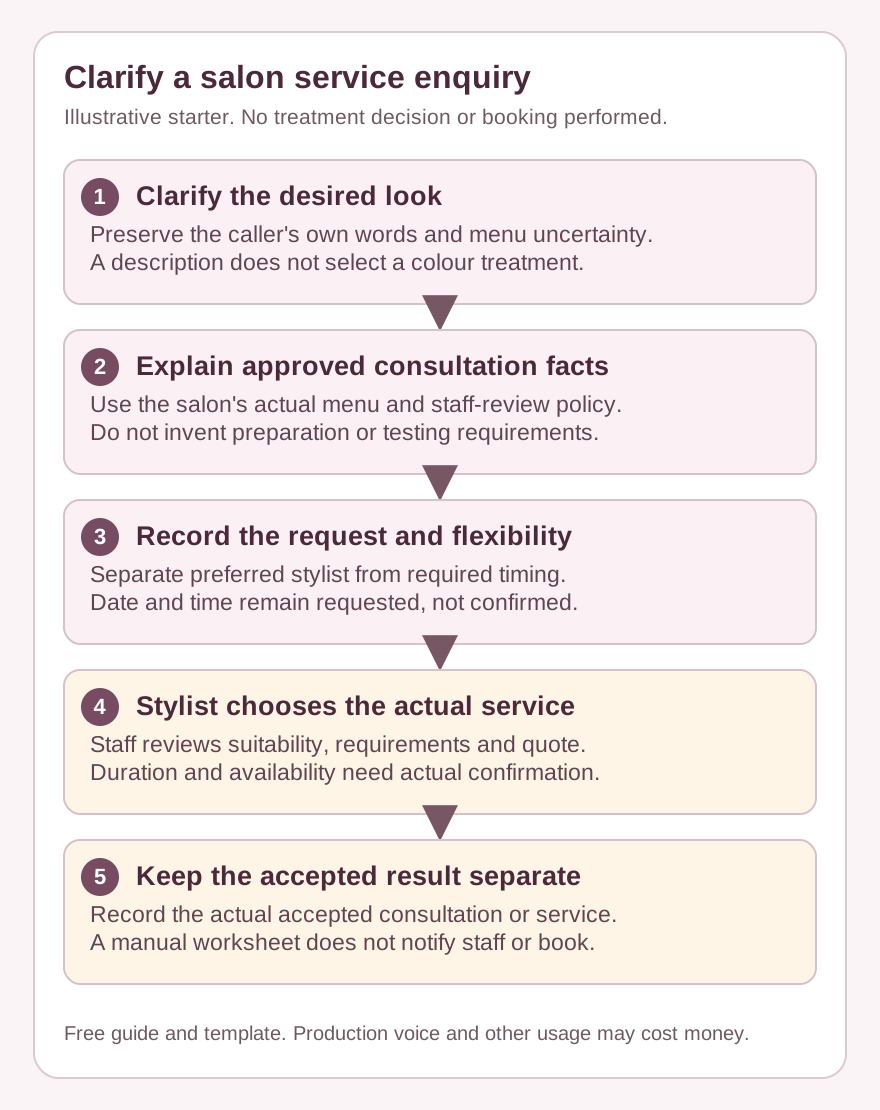
A description is useful even when a service has not been chosen. This outline is a planning aid, not evidence that a booking or treatment assessment was performed.
Create the receptionist and give it this specific job
In Burki, open Assistants → New assistant → Set up manually and choose Receptionist. Under Conversation, the business setup includes Assistant job, Business name, Business facts and Desired outcome.
Select Receptionist in Assistant job. Put the salon's approved name and facts into the corresponding fields. The job selector is a role choice; the specific task belongs in Desired outcome and Instructions.
For the fictional example, set Desired outcome to:
Clarify a new caller's desired look and menu uncertainty, then prepare a colour consultation request for stylist review with their preferred date, stylist flexibility and approved follow-up route. Do not choose a treatment, promise a quote or confirm an appointment.
Choose Apply business details to instructions, then inspect the resulting Instructions and First greeting. Applying these details does not save the assistant or prove the generated wording fits the salon's policy. Replace fictional information before choosing Create assistant. For an existing assistant, review the current settings before Save changes.
The starter's instruction block uses these rules:
Ask what the caller wants to change in their own words. Explain service descriptions only from approved salon facts. If the named service and desired look do not clearly match, preserve the uncertainty and offer the approved consultation route. Do not select a colour process, estimate treatment suitability or promise a duration or quote. Separate preferred stylist from required timing. Treat consultation dates as requested until staff accepts them. Never claim staff received a message or an appointment was booked without an actual result.
Under Voice, review the configured model, speech recognition, voice, provider credentials or managed funding and language requirements. Saving the assistant does not assign a telephone number or prove that its phone route is ready.
Read Publish → Published version before changing an existing assistant. Published assistants use their published version for telephone calls; saved edits remain drafts until Publish saved changes. A new unpublished assistant needs a reviewed Publish assistant step before connecting real calls. If legacy live settings is shown, saving can change connected calls; plan for that actual status. Publication freezes settings and selected actions, while knowledge content, provider credentials and policies, and calendar availability remain live. Publishing does not itself verify the phone connection.
Work through an ambiguous colour enquiry
Here is an illustrative exchange, not an observed Burki call. The fictional salon uses its stated local timezone; Thursday is October 15, 2026.
Caller: I'd like to book full highlights next Thursday after four.
Assistant: I can help prepare a request for the stylist. What would you like to change about your hair?
Caller: Actually I just want the front brighter and the rest to stay dark. I'm a new client, and I don't know what that service is called. I'd prefer Bea, but someone else is fine. I need to know the cost before I decide.
Assistant: I've noted brighter pieces at the front while keeping the rest dark, and that you haven't chosen the service yet. Alder Lane Hair asks new colour clients to start with a staff consultation. You'd prefer Bea but can see another stylist, and you're requesting Thursday, October 15, after 16:00 in the salon's local time. Staff need to review the request and confirm the service and quote. What follow-up route would you like them to use?
The response preserves the goal rather than confirming “full highlights.” It follows the fictional salon's approved consultation fact, distinguishes stylist preference from flexibility and keeps the requested time pending. Staff still need to answer the cost question.
The manual record should contain:
| Field | Worked value |
|---|---|
| Initial menu term | Full highlights, caller's first wording |
| Desired look | Brighter front, rest remains dark |
| Service selected? | No; caller says they are unsure |
| Client context | New client, volunteered by caller |
| Requested next step | Staff colour consultation |
| Stylist preference | Bea preferred; another stylist acceptable |
| Requested time | October 15, 2026, after 16:00, salon local timezone |
| Quote question | Needs cost before deciding; staff answer pending |
| Appointment accepted? | No |
| Follow-up route | Ask the caller; not supplied in this example |
If the caller later changes the time or clarifies a different goal, preserve that correction. Do not let the first menu term dominate the record after the caller has explained otherwise.
Review the actual record with staff
Where your actual channel retains a transcript, inspect that call record and use what was actually said. The downloadable worksheet is a manual resource; it does not deliver a notification, connect to Fresha, Phorest or Treatwell, or create a staff task automatically. If the channel does not retain the needed record, do not claim the request is available for later review.
Keep a separate stylist section for the final service decision, requirements, confirmed duration, actual quote and accepted appointment. The caller's intake description should remain intact so staff can see how the enquiry developed. A requested consultation is still pending even if staff have opened the worksheet.
If you later add an appointment or staff-notification action, verify its actual permissions, resource mapping and delivered outcome. An accepted calendar request can still be the wrong service, stylist or duration. Do not describe an integration as ready from a saved configuration alone.
The AI receptionist page describes the commercial use case. This starter keeps the initial task focused on service clarity and staff review so you can assess it before widening the automation.
Check the cases that matter for a salon
Prepare these cases before routing public traffic:
- Menu name and desired look conflict. The assistant should preserve both and use the approved consultation route, rather than select a treatment itself.
- Stylist preference is flexible but time is required. The record should not turn either preference into guaranteed availability.
- The caller demands a fixed quote or duration. Use only approved information; keep a pending stylist question where the answer is unknown.
- The caller asks to skip a preparation or testing requirement. The assistant should not waive the salon's actual policy or invent a new one.
- The caller corrects the date or requested outcome. Read back the relevant correction and preserve the new value.
- Staff have not replied. Use the actual approved next step, without claiming delivery, acceptance or a callback already arranged.
These are proposed checks, not fabricated results. Burki text evaluations can help inspect responses from saved instructions after a cost review. They do not test audio, perform a booking or assess treatment suitability. Verify the channel and any real action under separately approved conditions.
After launch, use attributable caller questions and staff-reviewed records to improve the guide and instructions. Look for misunderstood menu terms, missing flexibility and requests staff could not resolve. Count accepted consultations only when the actual outcome can be linked. Keep unknown attribution as unknown rather than manufacturing savings or conversion claims.
Ready to try Burki?
Create an assistant and check your available browser practice allowance.
Create your assistantTrial eligibility and available practice are shown in your workspace.