Soniox vs Inworld: Custom Voice Readiness
Compare Soniox TTS v2 and Inworld TTS-2 custom voice preparation, costs and scoped latency evidence, with a free worksheet for evaluating an authorized voice.
Table of Contents▼
For a custom business voice, the first question is whether the intended model can use the prepared voice in the correct account. The second is whether listeners can understand it and recognize the intended speaker. A successful upload does not answer either question by itself.
This Soniox vs Inworld voice cloning comparison examines tts-rt-v2 and inworld-tts-2 as of October 23, 2026. It compares preparation, evaluation and operating cost. It does not declare a cloned-voice winner: we found no matched study of these exact models using the same authorized reference speakers under a documented cloning protocol.
Download the free custom voice readiness worksheet. It contains an original evaluation plan, scripts and empty observation fields. No voice was cloned, generated or listened to for this article. The resource is free; provider preparation, synthesis and production service can have costs.
Compare the current models and preparation routes
Soniox lists TTS v2 as active, with general availability dated August 11, 2026. Its earlier v1 family is deprecated; the provider documents automatic routing to v2 after August 31. An old alias in an application is therefore not sufficient evidence of the model that executed. Soniox model lifecycle.
Inworld's current model identifier is inworld-tts-2. Its API release notes date the launch entry to May 5, while the canonical announcement labels general availability August 31, 2026. This is a current capability comparison, not a claim that either model launched today. Inworld release notes, Inworld general availability announcement.
| Preparation decision | Soniox TTS v2 | Inworld TTS-2 |
|---|---|---|
| Voice scope to verify | Correct Soniox project | Correct provider workspace and voice |
| Short-reference route | Asynchronous voice preparation for a model | Instant cloning |
| Longer training route discussed here | No equivalent professional-training route established | Professional Voice Cloning, beta |
| Evaluation still required | Identity, words and intended language | Identity, words and intended language |
Soniox's cloning procedure and Inworld's instant and professional guides describe different preparation contracts. A longer input allowance or a more elaborate training flow is not a quality score.
Prepare Soniox for the exact model
In the Soniox Console, open the intended project, choose Voices → Create voice, upload a clear single-speaker reference and give it a unique name. Current limits are two minutes and 35 MB, with 20 voices per organization. The voice is prepared asynchronously per model. Use its UUID in voice only when that model is ready. Current Soniox cloning contract.
When a later TTS model appears, an existing voice may need recomputation. That processes unprepared models; it does not recover a failed voice. Correct the reference and create a new voice after a terminal failure. Soniox preparation lifecycle.
For your own acceptance record, keep the provider, project, model and voice identifier together. Give the record an internal version such as studio-host-reference-01. If someone changes the reference, preserve that as a new version instead of leaving the old approval attached to a different voice.
The operational distinction is useful during diagnosis. A voice visible in a list may still need preparation, while a voice accepted for one model does not establish readiness for another. Check the relevant state before investigating pronunciation or listener preference. There is no useful sound-quality result to score if synthesis never reached an eligible voice.
Choose the intended Inworld preparation route
For instant cloning, open Text-to-Speech → Create Voice → Upload or record audio in Inworld Portal. Select the sample's language and confirm your rights to use the voice. Current guidance allows a prompt from three to 30 seconds, one upload up to 12 MB, in WAV, MP3 or WebM; longer audio is trimmed. Copy the resulting voice ID for provider synthesis. Inworld instant cloning.
For a larger reference set, Professional Voice Cloning is a separate beta workflow: Start professional clone, name the voice, select the matching language, upload samples and start training. It requires at least 10 minutes, allows up to 50 samples totaling 1 GB, and normally takes 30–60 minutes to train. English is fully supported; other-language support is experimental. Use the trained voice only after readiness. Professional cloning procedure.
Do not turn these routes into an unfair bake-off. If the business can supply only one short approved recording, compare the two short-reference paths. If it can supply a larger authorized collection, evaluate professional preparation as a separate experiment, with its additional input and preparation effort recorded. Otherwise, an apparent model difference could simply be the result of giving one candidate a much richer reference.
Use a provider's current detailed procedure when preparing the voice. An older launch post can describe a former limit, while a current workflow may accept something different. Retain the preparation date and the source you used with the review record.
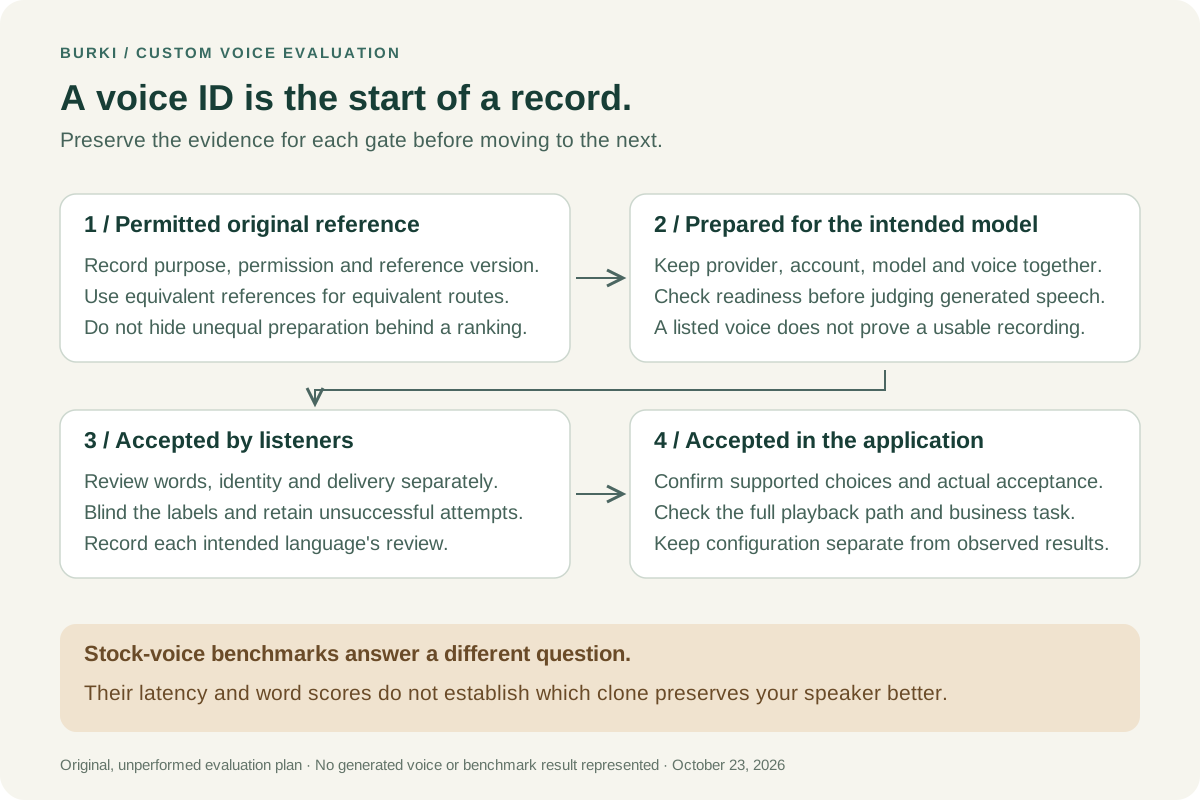
The diagram is an evaluation plan. Passing one gate does not supply evidence for the next.
Read the available stock-voice benchmark at its actual boundary
Cekura's report, updated October 19, compares these models on the same 104 English agent sentences, three reads each, from US East, using one stock voice per model. Its table uses Sarah for Inworld and Emma for Soniox. These are component measurements, not recordings of your prepared speaker or a complete Burki telephone conversation. Cekura pair results, published methodology.
| Cekura median | Inworld TTS-2 | Soniox TTS RT v2 |
|---|---|---|
| Whole text sent → first audible sound | 126 ms | 241 ms |
| Last streamed word sent → first audible sound | 127 ms | 183 ms |
Connection, authentication and setup precede the timing boundary. The benchmark's first-audible detector uses a fixed amplitude rule; it is not a handset listening test. Carrier transport and the complete application playback path are outside its scope. The linked harness is pinned at 8b4c736e7ad9ccbd91130d84d56f40edb3c1fb6a; that reference does not by itself establish the code used for every published run. Its README also contains differing corpus-version labels, so no single corpus version is asserted here. Pinned benchmark conventions.
Cekura separately reports 93.4% and 83.6% for hard spans read correctly, respectively. This is an estimate produced using transcription, not human listener accuracy or cloned-speaker similarity. Its naturalness metric is also model-estimated rather than a human opinion study. Pair scores, scoring method.
These results justify checking response timing and critical words separately. They cannot answer which provider will preserve a particular person's identity better. Do not combine the latency medians, a vendor percentile and an unrelated voice-similarity rating into one league table.
Design a fair custom-voice acceptance check
Consider a fictional community studio whose adult host has authorized a custom voice for administrative replies. The first task is to explain how to submit a workshop enquiry. It is not to imitate the host in unrestricted conversations or imply that the host personally spoke each generated sentence.
Use the same permitted original reference for each short-reference candidate, within both providers' limits. Keep the recording environment, script version, output format and intended listener language stable. Do not make a new provider's reference by copying another model's generated audio: that changes the source of the comparison.
Prepare three kinds of script:
- Ordinary service information. “The workshop enquiry is a request. A team member will confirm the available dates.” Check that “request” remains clear.
- A correction and identifier. “The reference is B7, not D7. The entrance is beside the garden gate.” Check the correction and letters independently.
- Longer delivery. Explain what information a team member needs, then ask one brief question. Check whether the voice stays understandable throughout, rather than scoring only its opening greeting.
These passages are original, unperformed fixtures. Before generating anything, decide which errors would make a recording unusable. A pleasant voice that changes a request into a confirmed booking should fail the content check, even if a listener prefers its tone.
For identity review, ask authorized reviewers to compare blind-labelled recordings against the permitted reference. Separate “resembles the intended speaker” from “sounds natural” and “I understood the important information.” Include the reference quality and reviewer familiarity in the record. Keep failed attempts in the cost and failure totals; selecting only the best clip hides the task's actual difficulty.
Run a separate language review for each intended audience. Soniox documents 60+ languages; Inworld documents 200+ languages and locales. Coverage counts do not establish equal cloning quality, accent suitability or a Dubai dialect outcome. Soniox current model coverage, Inworld current model coverage.
Budget for preparation and accepted output
Soniox currently lists USD 4 per million input text tokens and USD 21.50 per million output audio tokens, describing roughly USD 0.70 per generated hour. Use actual token records for reconciliation. Soniox pricing.
Inworld's current On-Demand TTS-2 rate is USD 25 per million characters; paid plans have different rates and credits. Professional clone slots and training limits depend on plan, and On-Demand professional cloning requires a payment method. Inworld pricing, professional clone limits.
For an illustrative Inworld calculation, 100,000 billable characters at that On-Demand rate produce USD 2.50 in synthesis usage. For a separate illustrative Soniox record with 30,000 input text tokens and 60,000 output audio tokens, the listed rates produce USD 1.41. These are different hypothetical usage records, not a matched price comparison or evidence that one provider is cheaper for the same task.
Before choosing, budget the same planned scripts and retain the actual provider units for all attempts. Divide the resulting costs by accepted output only after the acceptance decision. Preparation time, storage, LLM work, application charges and telephone service need separate entries. A cheap discarded recording does not complete the business task.
Check Burki's available choices before planning deployment
In the inspected October 23 Burki editor, inspect Conversation engine under Voice → Model and provider choices for Standard pipeline · advanced provider choices. Then open Voice → Speech settings → Advanced voice stack → Voice provider, where Soniox and Inworld are visible. These are inspection steps; do not change the conversation engine merely to follow this guide. Provider visibility does not establish availability of these exact models or a completed custom-voice preparation workflow.
The current source catalog still lists Soniox v1 identifiers and earlier Inworld model families. A provider's alias policy may route an older name, but it does not prove the model or prepared voice accepted by a particular worker. The exact voice worker source was not established for this comparison. Do not paste a new model identifier into a custom voice field to try to add model support.
Use the options actually offered, check readiness and Usage & billing, and keep configuration evidence separate from provider acceptance and listener results. For an AI receptionist, the practical objective is clear, accurate business information with an appropriate voice. A custom voice can be considered after the conversation engine and workflow fit the task; the voice evaluation guide helps keep that decision tied to evidence.
Ready to try Burki?
Create an assistant and check your available browser practice allowance.
Create your assistantTrial eligibility and available practice are shown in your workspace.