Eleven Realtime v1 Mini vs Max
Compare Eleven Realtime v1 Mini and Max by current access limits, published reasoning and task benchmarks, connected-audio pricing and an original evaluation worksheet.
Table of Contents▼
Choosing between Eleven Realtime v1 Mini and Max starts with the task and the deployment's eligibility. A brief factual conversation and a multi-step tool task need different acceptance checks. A model's name or one latency number cannot make that choice for you.
The exact identifiers are eleven_realtime_v1_mini and eleven_realtime_v1_max. ElevenLabs' public launch is dated October 20, 2026, following an October 19 documentation entry for gradual workspace rollout. This comparison checks their current contracts on October 24. Launch announcement, dated changelog.
Download the free model-selection worksheet. It includes two original tasks, an eligibility record and empty result fields. We ran no calls, provider generations or model benchmarks for this article. The worksheet is free; provider sessions and production service can incur charges.
These are complete voice configurations, not two TTS models
Eleven Realtime combines speech recognition, turn handling, a language model and speech generation. Mini targets natural conversation; Max targets more complex instructions and multi-step tool use. Both support 90+ languages. The separate Eleven v4 vs v4 Turbo guide compares speech-generation components, which are a different choice. Eleven Realtime product overview.
Keep the surface fixed when comparing candidates. ElevenAgents and the direct Realtime API are separate products. The direct API uses WebSocket, with no WebRTC support at launch, and does not supply the ElevenAgents channels and knowledge-base features. “Compatible with a familiar realtime protocol” is not proof that an existing telephone application can switch providers without other work. Current Realtime API boundaries.
For the first experiment, write a single sentence describing success. “Explain the approved visitor procedure accurately” is useful. “Sound like the best model” gives a reviewer little to test. For a tool task, define the intended final state separately from how polished the conversation sounds.
Check eligibility before comparing recordings
In ElevenAgents, open the Agent tab, set Voice mode → Realtime, then select Mini or Max in Model and review publication. Workspace rollout can make the mode unavailable. Max requires a token limit of at least 1,024, or no limit. Its current availability excludes the India and Singapore residency environments. Check the provider's retention and regional eligibility table for your own account. Realtime model configuration.
Realtime mode also has restrictions on custom LLMs, managed-setting workflow overrides and transfers between voice modes. A draft can save while failing publication checks. Do not interpret a saved draft as evidence that the configuration is deployable. Current mode limitations.
Record the actual route, model identifier, permitted voice and current account eligibility in the worksheet. If one candidate is not available under the deployment's requirements, mark it ineligible for that deployment rather than giving it an invented zero performance score. A capability restriction and a failed conversation are different outcomes.
Read reasoning and response timing on the same benchmark
Artificial Analysis' current speech-to-speech table displays the following results, observed October 24, 2026:
| Big Bench Audio result | v1 Mini | v1 Max |
|---|---|---|
| Reasoning accuracy, rounded display | 76% | 99% |
| Mean time to first audio | 0.62 seconds | 0.57 seconds |
These are independent benchmark results from Artificial Analysis. They are not Burki measurements. The observation date is when this guide checked the table; the individual run dates and exact client region were not established here.
Big Bench Audio contains 1,000 English spoken reasoning questions across four Big Bench Hard categories, using 23 synthetic voices. A judge assesses the spoken answers against the question and reference answer. Time to first audio is a mean to the first audio output token on that question set. It is not a handset's first audible word or a tail-latency percentile. Benchmark methodology, author's dataset and language card.
On this workload, Max has the higher displayed reasoning result and the lower mean first-audio time. That does not establish that Max starts every conversation sooner. The table provides no uncertainty interval for the 50-millisecond timing difference, and a reasoning exercise does not reproduce every receptionist's language, channel or tool use.
The current independent table rounds reasoning percentages. Do not combine its rounded values with more precise launch figures and imply they are a single measurement snapshot. Use a dated record of whichever source and precision you actually reviewed.
Keep task completion separate from preference
Artificial Analysis' Speech Agent Arena uses blind live conversations. Its current rows show:
| Arena measure, checked October 24 | v1 Mini | v1 Max |
|---|---|---|
| Preference Elo, 95% interval | 988; 960–1016 | 997; 970–1025 |
| Listed samples | 613 | 638 |
| Eligible task success rate | 60.3% | 87.1% |
| Task-success 95% interval | 54.3–66.0% | 82.6–90.6% |
The preference intervals overlap, so these rows do not establish a clear overall listener-preference winner. The task-success figure answers a different, narrower question. Current Arena results.
The Arena has 35 scenarios, comprising 15 with tools and 20 without. Task success concerns the correct final task-completing tool calls in eligible conversations; participant deviations and unverifiable cases are excluded. The listed sample count should not be assumed to be that rate's denominator. Arena evaluation method.
This is useful evidence for evaluating complex tool work, with its conditions intact. It is not an admissions rate, booking guarantee or forecast that a business will complete that percentage of calls. Nor does the benchmark establish current accuracy for a particular language, accent or integration. Avoid averaging the reasoning percentage, Elo and task-success percentage into a new score of your own.
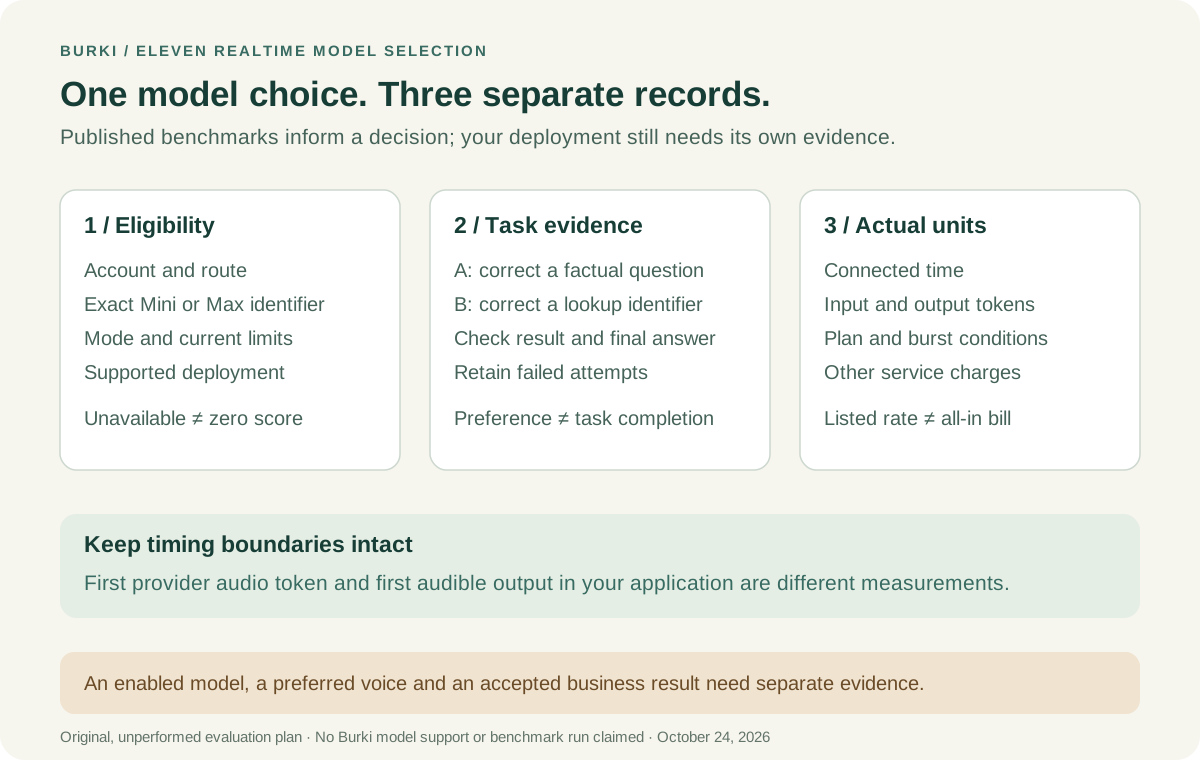
The diagram describes an original selection process. It shows no results from a performed Burki or provider evaluation.
Evaluate two original tasks before committing to a model
Use the same approved facts, voice and request surface for both candidates. Retain every attempt, including failures. Keep an initial factual task separate from a tool task so the review can identify what changed.
Task A: explain an approved visitor procedure. Fictional Alder Workshop asks visitors to use the side entrance for an evening event. Doors open at 18:15; the event begins at 18:45. The caller first asks when doors open, then corrects the question to when the event begins. Expected handling: answer 18:45 and preserve the distinction. No ticket sale or admission is implied.
Task B: resolve a corrected enquiry with a read-only tool. In a mock event-information system, the caller changes the requested code from WOOD-01 to PAPER-02. The mock lookup returns the room and entrance for the selected code, or an explicit unknown result. Expected handling: use only PAPER-02 after the correction, read back its approved location, and leave missing facts unknown.
These are original, unperformed fixtures. The worksheet describes a tool result you can mock in an implementation you own; it does not claim a provider connection or installed integration. A reviewer should record whether the intended tool ran with the corrected input and whether the final answer matched its result.
The distinction matters when diagnosing a failure. If the lookup returned the wrong row, changing the speech model would not repair the data source. If it returned the right row but the answer used the earlier one, preserve that evidence as a candidate conversation failure. If the provider never accepted the configuration, keep it outside the set of completed conversations instead of silently hiding it.
Decide the rejection criteria in advance: a wrong event time, reuse of a corrected identifier, fabricated admission or a claimed action without evidence should fail the task. Listener preference can be recorded separately after those checks.
Calculate the route's cost, including token usage
For the direct Realtime API, current pricing lists USD 0.08 per additional connected-audio minute for either model, plus the token rates below. Burst connected-audio pricing is USD 0.16 per minute above the applicable concurrency limit. Included-minute estimates depend on typical token use. ElevenAPI pricing.
| Direct API token price, USD per million | Mini | Max |
|---|---|---|
| Input | 0.20 | 1.80 |
| Output | 6.00 | 9.00 |
For a deliberately simplified illustration, assume 100 additional connected minutes, 100,000 uncached input tokens and 20,000 output tokens, outside burst usage. Applying those displayed rates gives USD 8.14 for Mini or USD 8.36 for Max. These are hypothetical meter records and arithmetic, not observed consumption or an account quote. Credits, taxes, cached usage, other services and the applicable plan must be reviewed separately. Current direct API tariff.
ElevenAgents instead uses its applicable platform minute rate plus model tokens. Do not transplant the direct API example into an ElevenAgents bill or combine it with TTS character pricing. Realtime billing routes.
Use actual units for the same evaluation workload when comparing costs. More expensive tokens do not reveal the complete cost per successful task without knowing how many tokens and attempts the workflow uses. Keep the unsuccessful attempts and connected time in the record.
What this means for a Burki setup
The current Burki runtime does not establish native support for either Eleven Realtime identifier. Its existing ElevenLabs speech-provider support is a separate capability. A custom LLM endpoint or the GPT Live conversation-engine label does not create a bridge to ElevenLabs' Realtime API.
For a Burki AI receptionist, inspect the actual options under Voice → Model and provider choices, then review the task, provider credentials and funding for the supported engine. The conversation-engine guide and voice evaluation guide help organize that review.
The published evidence makes Max a relevant candidate for harder reasoning and tool tasks, while access and the actual task still govern selection. It does not establish a universal winner, native Burki availability or a successful provider run. Keep the configuration decision, test observation and production result as separate records.
Ready to try Burki?
Create an assistant and check your available browser practice allowance.
Create your assistantTrial eligibility and available practice are shown in your workspace.